What the free check of your website tells you.
You send the address, the business name and the town. Within 24 hours you get a report that says where the site stands, what holds it back most and what I would fix first.
You had your site made a few years ago. It works, and nobody complains. But you don't know whether it opens quickly on a phone in a café with a weak signal, whether Google sees it the way it should, or what an AI assistant says about your business when someone asks it for a recommendation. That's what the free check is for.
It makes the most sense when you have a site but don't know whether it works for you. If it was made by someone who no longer answers, if you put it together yourself in some tool, or if nobody has touched it for years, the report tells you where you stand.
How to send it.
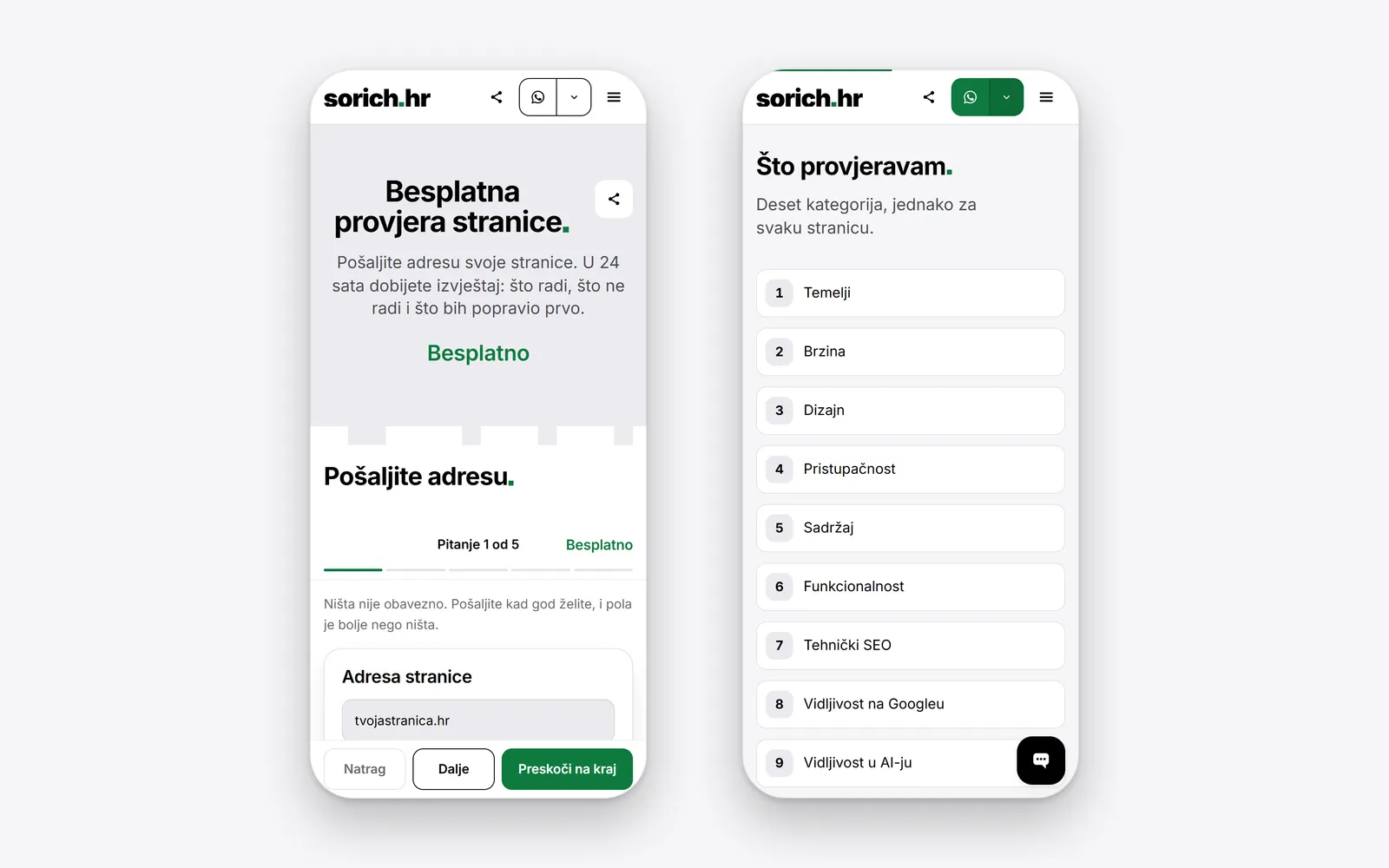
On the website check page you enter three things: the site's address, the business name and the town. The message goes to WhatsApp, and that's all. I don't need access to your site, passwords or any software. I look at what every visitor, Google and AI can see.
The report arrives within 24 hours. I do the check myself, with the help of AI tools, and I measure speed with a public speed test that anyone can repeat.
The check is free because it's an honest way to show you how I work: instead of promises you get a concrete list. It commits you to nothing.
The ten things I look at.
The categories are the same for every site, so your site today can be compared with the same site a year from now.
- Foundations: the address and a secure connection, your domain and an e-mail that doesn't end up in spam
- Speed: how fast the site opens, measured rather than guessed
- Design: whether a visitor sees at once what you do and how to reach you
- Accessibility: whether people with weaker sight, or who use only a keyboard, can use the site
- Content: whether the copy is clear, accurate and written for the people looking for you
- Functionality: whether the buttons, forms, calls and links work
- Technical SEO: titles, descriptions, structure and the data a search engine reads
- Visibility on Google: your Google profile, the map, reviews and how you show up when someone searches for you
- Visibility in AI: whether AI assistants know about you and what they say
- Trust and legal: who is behind the business, business details, reviews, cookies and privacy
Three questions and three problems.
The report opens with an overall score and answers to three questions that every owner asks themselves. Do they find you: do you show up on Google, on the map and when someone asks an AI assistant. Do they trust you: once they find you, does everything look serious, accurate and checkable, from your business details to your reviews. Do they get in touch: does the site open quickly on a phone, and can anyone contact you with one tap.
Only what I actually measured gets a score. What I couldn't check appears in the report as not measured, not as a made-up number.
Then come the three biggest problems. Not a long list of small things, but the three that hold you back most, explained so you understand them without technical vocabulary. For example: a phone number you can't tap on a phone, old opening hours on Google, or a site that opens slowly on a phone.
What AI says about your business.
In this part I ask AI assistants what your future guest or customer would ask them: who in your town does what you do, and what they know about you. I copy their answers into the report as they are. Sometimes they're right. Sometimes they mix up the opening hours or the address, or don't mention you at all. When you see it in black and white, it's clear why the way your details appear on the web matters. How AI chooses whom to recommend I explain in how AI chooses.
What I would do first.
The report ends with a list of steps, in the order I would take them. The list starts with steps that cost nothing: things you can fix yourself, in your Google profile or on your current site, with a short instruction. Only after those come the steps you need me, or someone else, for.
Every step you need me for carries one of three marks. Green: I fix it and I guarantee it. After the work I run the check again and that item must pass, and if it doesn't, I fix it at no charge. Yellow: I do the work, but the outcome depends not only on me but also on customers, Google or AI, as with reviews. White: nobody honest can promise that, like a place on Google or a recommendation from AI.
The last sentence of the report is a question: "Would you like me to fix it?" If yes, get in touch and we agree the scope. If not, the report stays yours to use as you like.
For the steps I do, I send you an offer, and we agree the scope and the price before I start work.
What the check is not.
The check isn't a promise of a place on Google, and I won't promise you one even after everything on the list is fixed. It's an honest snapshot: what works, what doesn't and what would pay off first. Why nobody honest promises a ranking I explain in SEO without promises.
What I can make of this for you.
If you want to know where your site stands, send the address and the report arrives within 24 hours. If it shows the site needs more than small fixes, there's SEO and AI visibility or a new website.